The world's first 1,000 km battery life + 4C supercharged lithium iron phosphate battery is released
author: Pro
2024-04-23
"The ultra-long battery life of 1,000 kilometers is equivalent to driving from Beijing to Nanjing without needing to recharge in the middle." On April 25, the world's first new lithium iron phosphate battery product "Shenxing PLUS" that combines 1,000km battery life and 4C supercharging characteristics was launched in Beijing. Launched at the International Auto Show.
Behind the "thousand-kilometer-level" pure electric battery life, it is inseparable from the continuous breakthroughs in technology. "We use particle grading technology in the positive electrode to place each nanoparticle in the appropriate position to achieve ultra-high compaction density; we add self-developed three-dimensional honeycomb material to the negative electrode to increase the energy density of the negative electrode and It effectively controls the volume expansion during charging and discharging; at the same time, the industry's first integrated shell structure is developed in the battery cell structure design, which greatly improves the space utilization inside the battery cell." Wu Kai, chief scientist of CATL, added that the phosphoric acid. The lithium iron battery is topologically optimized based on the third generation module-less technology CTP 3.0, making full use of the energy bin space and increasing the volume group efficiency by 7%. With double breakthroughs in materials and structures, the energy density of the Shenxing battery system exceeded the 200Wh/kg mark for the first time, reaching 205Wh/kg, making it possible for the vehicle to last more than 1,000km.
"Not only does it have a long battery life, it also charges quickly. It can recharge for 600km of battery life in 10 minutes." Gao Huan, CTO of CATL's domestic passenger car division, said that in order to increase the charging speed, this lithium iron phosphate battery uses a fast ion conductor. Technologies such as coating, transition metal doping, and new nano-coating make energy transmission between positive and negative electrode materials easier and more efficient. And by expanding the over-current area and over-current capacity of the pole, it ensures rapid cooling even during high-current charging. In terms of BMS core algorithm, the newly developed AI intelligent polarization model can estimate and control the charging current in real time, making energy replenishment faster and smarter.
The difference between pure sine wave and corrected sine wave of inverters, as well as the selection, usage method, and precautions of on-board inverters(1)
CATL launches Shenxing PLUS battery, which can charge 600 kilometers in 10 minutes and has a range of over 1,000 kilometers(2)
Related Article

System‑Level Engineering For Compact Portable Power‑Station Architecture
Bridna 300W Outdoor Portable Solar Power Station: Compact Engineered Energy Unit For Field And Emergency Deployments
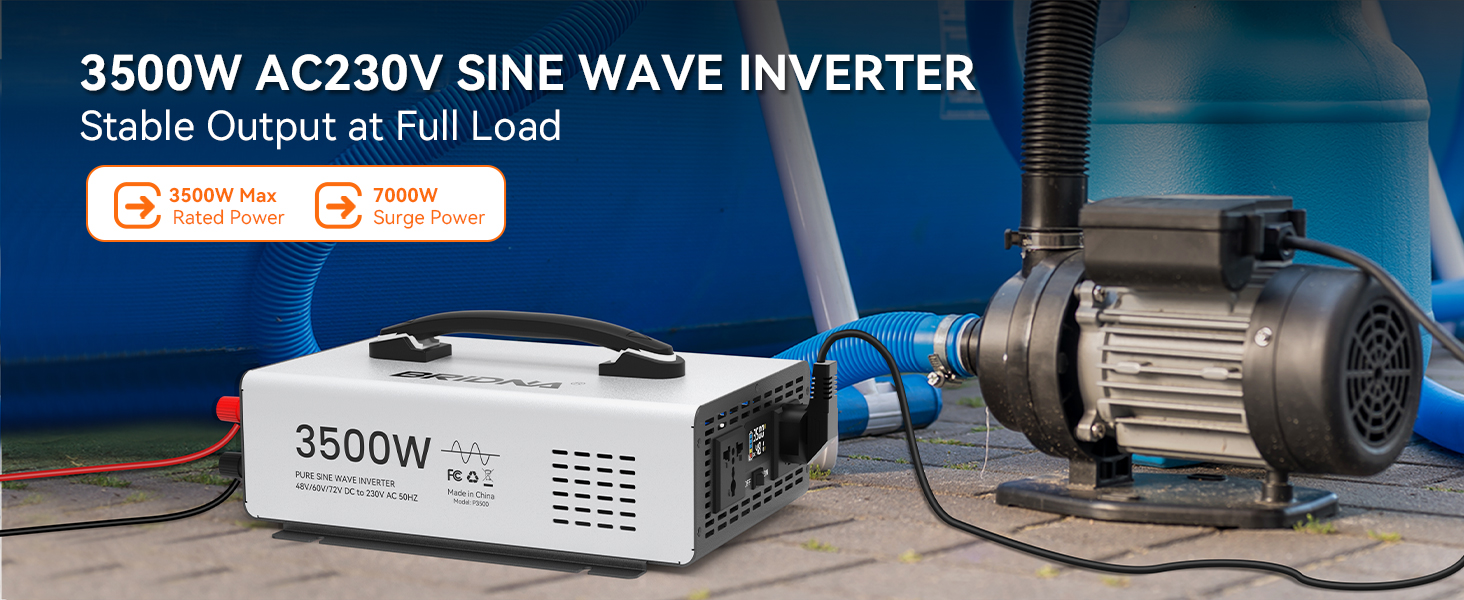
Product Tech Article | Vehicle‑Mounted Power‑Electronics For Integrators & Wholesale Partners
Bridna 3500W Power Inverter: Engineered Power‑Electronics For EV Emergency Backup And RV System Integration