The Rigor Behind Every Watt Begins on This Production Line
At Bridna, silence doesn't exist.
Not noise, exactly—but a low, steady pulse. It comes from pneumatic screwdrivers along the assembly line, from the hum of fans in the aging test chamber, from the crisp continuity beeps of multimeters at every workstation. This sound is the grammar of industry. It's Bridna's most direct translation of the word "reliability."
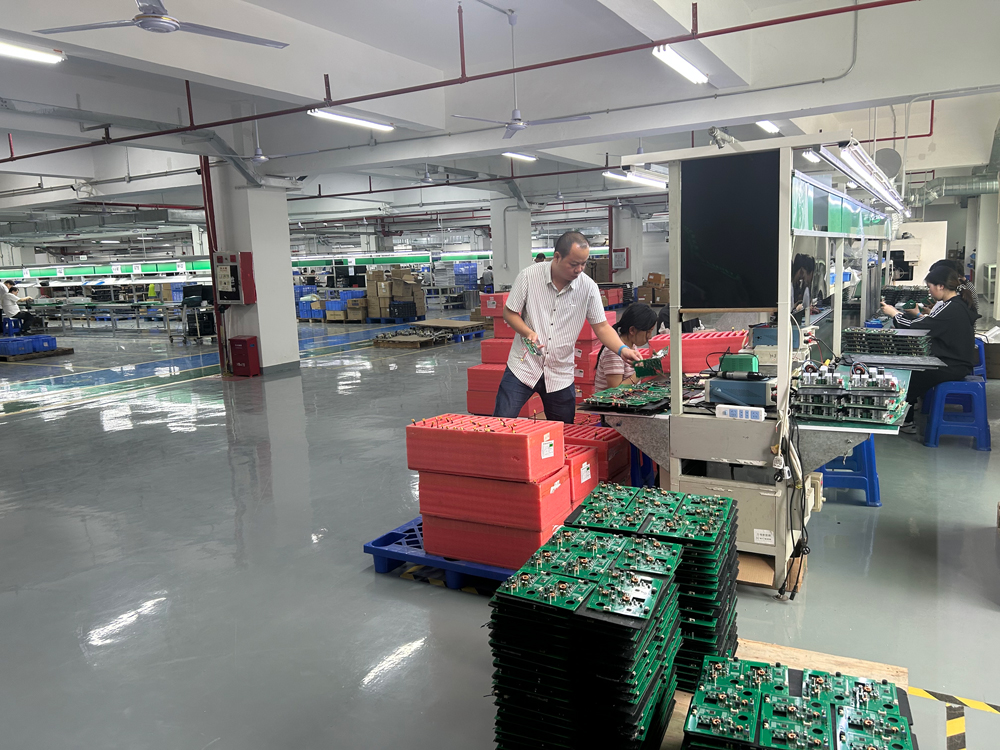
There are no spotlights here—only cool white fluorescent light reflecting off the anti-static flooring. What you see isn't a carefully staged showroom, but a live, fully operational reality: Bridna's core manufacturing facility.
Right now, this line is running at full capacity, delivering a batch of residential energy storage inverters bound for Northern Europe. For Bridna, it's just another ordinary day.
The first stop is the precision SMT workshop. Feeders spin continuously, placing microscopic components—MOSFETs, capacitors, control chips—onto FR-4 epoxy substrates with micron-level accuracy. This is the "brain" and "nervous system" of the inverter. Beneath the solder paste, invisible to the eye, lies a topology and circuit layout refined through hundreds of iterations by Bridna's engineers. We understand deeply: in the outdoors, at the edge of the grid, in extreme conditions—blizzards or scorching heat—there are no second chances.
Next comes automated optical inspection. Three AOI machines in series scan every PCBA with resolution far beyond the human eye. Solder joint quality, component polarity, alignment deviations—if any parameter falls outside our internal standards, the board is automatically diverted to the repair station. At Bridna, quality isn't just inspected—it's engineered. But any defect? It will never leave this line.
Look toward the assembly section. Here, precision meets power. Massive heat sink modules are perfectly mated to power devices by high-precision servo presses. Every screw's torque value is uploaded in real-time to the MES system. The moment a torque curve shows even the slightest abnormal spike, the workstation locks down automatically. This relentless traceability follows every component—from a single screw to the finished product.
The quietest, yet most unforgiving area, is the aging room.
Every inverter and portable power station must endure a minimum of four hours of full-load burn-in testing here. The temperature is set to 45°C, simulating the harshest cabinet environments. We monitor not just output parameters, but internal temperature rise, fan speed, even subtle fluctuations in electromagnetic interference. Our belief is simple: if it doesn't show weakness here, it won't fail you under the Sahara sun or in a Hokkaido blizzard.
In the final packaging area, you see another side of Bridna—a quiet confidence. Before each portable power station is sealed for shipment, it undergoes one last "breathing test": connected to a load, confirming USB-C fast-charge protocol handshake, verifying that the AC output waveform is as clean as the theoretical sine wave standard. Then, it receives a quality inspection card signed by the individual operator.
This isn't ritual. It's what "delivery" means to us: the moment a product leaves this factory, everything our brand stands for is entrusted to that metal box.
This is everyday life at Bridna.
No shortcuts. No storytelling. Just the relentless pulse of the production line, process parameters defined to three decimal places, and a near-obsessive commitment to "reliability" in every Bridna team member.
When your portable power station charges a drone on a remote ridge, or when your home stays lit during a blackout—you don't need to think about this line.
But we'll be here. Speaking the plain language of industry. Guarding every watt, so you're ready for whatever comes next.
BRIDNA SGR-PPS1800-1 Portable Power Station/All-Round Ports & Complete Specs, 1800W Pure Sine Wave Off-Grid Power Solution
Inverter: More Than Just "Voltage Transformation"
Related Article